
No Official Yancey 72-Hour Filter
The Yancey Sheriff’s public interface has one feature named Recent Arrests. Its configuration enables searching and descending date order with an initial ten-item view. It does not expose a 72-hour button, separate URL, or official rolling report. The linked inmate endpoint is the real source, but it contains mixed custody states and historical records.
On July 30, 2026, the research snapshot found 102 objects and records reaching back to a 2016 custody-status date. That old entry does not establish a retention promise. It does prove that the feed is broader than three days. A useful Yancey County three-day list must therefore be derived by timestamp, never by taking the first screen or assuming every displayed person left custody.
Build Yancey’s Three-Day Window
Start with an exact Eastern Time cutoff. Seventy-two hours is a rolling period, not the same thing as “the last three calendar dates.” At 2 p.m. Monday, for example, the rolling start is 2 p.m. Friday. That difference matters for a Friday morning event and for records added after an earlier weekend check.
- Write down the search end in Eastern Time and subtract 72 hours for the start.
- Open the official feed and identify every object with a Release Date inside that range.
- Compare the Release Date, Custody Status, and Custody Status Date. Do not replace one field with another.
- Separate
OUTfromTRANSFERRED. A transfer ends Yancey confinement but may continue custody. - Save the observation time and repeat the search after a reasonable lag if the newest hours appear incomplete.
- Ask detention staff for the existing release log covering the exact range when the result must be complete.
A last-day-only view is handled through the Yancey County 24-Hour Releases method. The three-day pass is designed to recover missed or delayed events, not to duplicate a daily check.
Yancey 72-Hour Release Fields
The feed’s fields should be read as a group. One date can show booking, another the recorded custody state, and a third the release. A record may omit some values. The source also lacks a consistently displayed release reason, so the field inventory cannot answer every disposition question.
| Field | Three-day use |
|---|---|
| Display name and inmate ID | Match the event and avoid confusing people with similar names. |
| Booked Date | Shows when the booking began; it does not define the 72-hour release period. |
| Release Date | Primary timestamp for inclusion in the rolling window. |
| Custody Status | Distinguishes IN, OUT, TRANSFERRED, and older UNSUPERVISED values. |
| Custody Status Date | May show a later source-system update, not the time custody first ended. |
| Reporting agency | Identifies the record source and confirms jurisdiction. |
| Image URL | May be a booking photo, placeholder, or time-limited VINE link. |
Identity descriptors and charge-array fields may also be present, but population varies by record. An unpopulated bond or charge field is not a release explanation. Obtain the sheriff release disposition or compare the court judgment instead.
Weekend Yancey Release Lag
A three-day view is most useful when office hours and data updates cross a weekend or holiday. The research did not establish a published Yancey feed cadence. The NCSWVINE source ID and later status timestamps indicate an integrated data path, but they do not justify a promise of real-time delivery. A release late Friday may be visible during the weekend, may arrive later, or may need direct confirmation.
Run the first check using the exact Release Date, then repeat after the period closes. If a name is missing, do not treat absence as proof that the person remained confined or never entered custody. Spelling, alias, ingestion lag, transfer, removal, or a missing field can affect the result. Call detention staff at 828-682-2124 for a time-sensitive status.
Note: A Monday search should retain the original Friday cutoff so a later update can be tested against the same three-day period.
Yancey Status Dates Can Differ
Yancey’s single Recent Arrests integration retains OUT, TRANSFERRED, and older UNSUPERVISED records alongside current entries. The July 2026 review also found examples in which an OUT or TRANSFERRED record’s status-update timestamp occurred days after its Release Date. That quirk is why sorting by the status date can place an older release inside a recent-looking group.
Use the explicit Release Date for the rolling calculation. Then use the status as context. OUT supports departure from Yancey custody, while TRANSFERRED requires a receiving-system search. Do not describe either as an unconditional community release unless the release disposition and custody trail support that conclusion.
The official interface manifest documents the one-feed design.
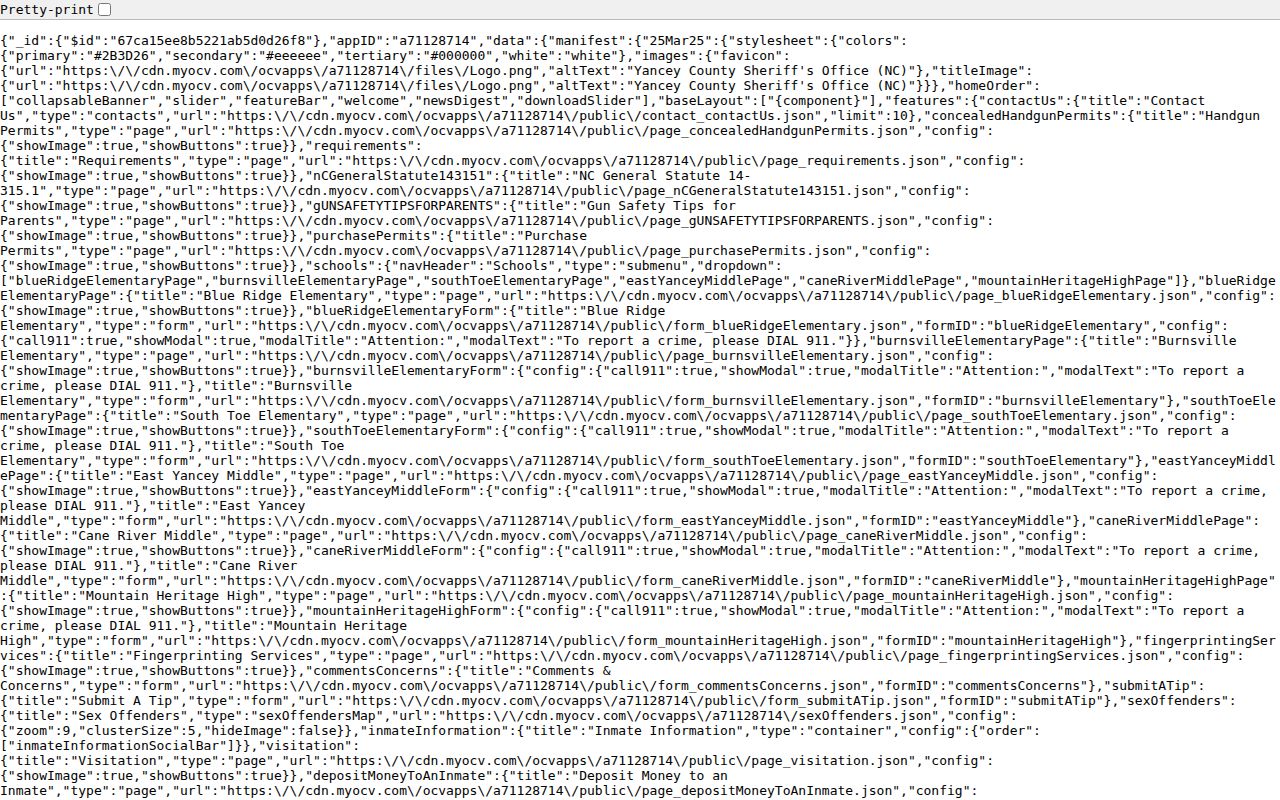
The manifest confirms search and sorting controls, but no actual 24-hour or 72-hour selector.
Request Yancey Three-Day Records
A records request can ask for an existing log covering a defined three-day span. It should not demand that Yancey County create a new 72-hour report or calculate conclusions. North Carolina G.S. 132-6.2 allows a requester to elect an available medium and generally limits uncertified copy charges to direct reproduction cost unless another law applies, but no local fixed fee or response time was found.
Follow the county request instructions. Complete the published form and email it to info@yanceycountync.gov, or deliver it to the County Manager’s Office at 110 Town Square, Room 11, Burnsville, NC 28714. State both endpoints with time zone. Request existing booking and release entries, recorded status or disposition, and transfer destination when public. Ask for electronic delivery and a cost estimate if reproduction applies.
Online display is not legal retention. A 2016 entry in one snapshot does not prove every record remains online for ten years. North Carolina DNCR schedules and Yancey’s adopted record series govern authorized retention. The custodian may still hold an underlying record after it leaves the public interface.
Confirm Each Yancey Custody Path
The correct fallback depends on what happened after Yancey confinement. The sheriff feed, detention phone, and county request are the primary routes for a local booking and physical release time. NC SAVAN or VINELink can corroborate a participating custody change and provide future notices. A court judgment can show dismissal, time served, probation, or sentence, but it is not the sheriff’s gate log.
| Observed path | Next source |
|---|---|
| OUT from Yancey | Sheriff release record and court disposition |
| TRANSFERRED to state custody | NCDAC offender detail and state release search |
| Another local jail | The named receiving facility |
| Federal criminal custody | Federal docket, holder, USMS, or BOP as the case requires |
| Documented ICE handoff | ICE locator and release paperwork |
For a named person whose trail spans systems, the Yancey released-inmate record search explains how to reconcile these sources. Federal tools should not be searched simply because a county name vanished.
Yancey Three-Day Results Change
A 72-hour result is a snapshot. New records can arrive, field values can change, and a photo link can expire. Keep the source, precise observation time, period endpoints, and status wording. When a later view differs, compare the records rather than assuming the first or second screen was complete.
The sheriff’s official app may offer another path to the same county information, but it does not create a distinct three-day ledger. Social posts can explain an incident or agency news, yet they are not a complete release log. The exact period request remains the best fallback for a reproducible Yancey County 72-hour release list.
Reconcile Yancey Court Timing
A three-day custody log and a court docket serve different roles. The judgment may show dismissal, probation, a sentence, or credit for time served. The sheriff record shows when Yancey custody actually ended. Processing, another warrant, a hold, or a transfer can place time between the court action and the gate event.
Compare both records when the release reason is not populated in the feed. Do not substitute a docket entry time for the Release Date, and do not treat an OUT code as proof of the judicial basis. The two-source check is especially useful across a weekend, when one system may update sooner than the other.